About Rotary Air Locks
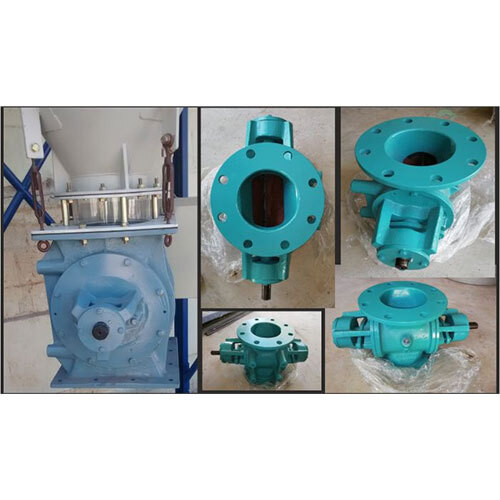
Presenting Anval's comprehensive Rotary Airlock Valve Range, tailored for a diverse array of applications spanning heavy minerals industries to light agricultural uses. With over two decades of expertise, Anval's valves are engineered to seamlessly manage tasks ranging from light-duty to heavy-duty operations, accommodating temperatures up to 500 deg C and volumes of approximately 815 mcube/hr. Renowned for their robust, customizable, and durable features, Anval Valves stand out as the preferred partner for bulk material handling. In a rotary airlock, vanes rotate, creating pockets filled with material entering through the Inlet port, circulating in a rotating motion, and exiting at the bottom through the Outlet port. Anval's rotary valves find applications in solid gas separation, solids metering, and serve various industries, ensuring a dust-tight seal and smooth operation with the implementation of "Labyrinth seals" on the rotating shaft, effectively handling abrasive products and differential pressure.
Versatile Rotor ConfigurationsChoose between open or closed end rotors, available with 6, 8, or 10 vanes to optimize air sealing and material throughput for your specific application. Both fabricated and cast construction rotors enhance adaptability to a range of bulk materials, from powders to granules and grains.
Robust Construction & Flexible InstallationDesigned with body thickness ranging from 8 mm to 20 mm and a choice of cast iron, mild steel, or stainless steel, these rotary air locks can withstand demanding environments. Installation is flexible with horizontal or vertical mounting options to fit various plant layouts.
Easy Maintenance & Reliable SealingThe units are engineered for quick and simple dismantling, allowing for fast cleaning and upkeep. Multiple sealing arrangements like gland packing, air purge, or Teflon options ensure optimal performance and prevent leakage in challenging process conditions.
FAQ's of Rotary Air Locks:
Q: How are the rotary air locks installed in various plant configurations?
A: These rotary air locks can be mounted both horizontally and vertically, allowing integration into dust collection systems, pneumatic conveyors, and bag filter units depending on your layout and process needs.
Q: What materials can be processed through these rotary air locks?
A: They are suitable for handling a wide range of dry bulk materials, including powders, granules, grains, and media up to 200C, making them ideal for diverse industrial sectors.
Q: When should I use an open end versus a closed end rotor?
A: Open end rotors are generally recommended for materials that might bridge or clog, promoting better flow, while closed end rotors provide enhanced air sealing, ideal for applications where pressure differential is significant.
Q: In what ways does the product simplify maintenance?
A: These air locks are designed for easy dismantling and cleaning, reducing downtime for servicing and ensuring a longer operational lifespan. Maintenance-friendly construction ensures smooth ongoing operation.
Q: What types of sealing arrangements are available, and what are their benefits?
A: You can select from gland packing, air purge, or Teflon sealing. These options provide effective protection against leakage, cater to different media properties, and contribute to better sealing performance under various conditions.
Q: What is the capacity range and how do I select the appropriate model for my process?
A: Capacity ranges from 5 m3/hr to 100 m3/hr, with power options from 0.5 HP to 5 HP. The right size depends on your material flow rate, pressure, temperature, and media characteristics.
Q: Where are these rotary air locks commonly used and what are the primary benefits?
A: Commonly used in dust extraction, pneumatic conveying, and bag filter systems, the main benefits include robust construction, reliable sealing against air loss, smooth material discharge, and easy adaptability to different industrial processes.




 Send Inquiry

 Send Inquiry
 English
 Spanish
 French
 German
 Italian
 Chinese (Simplified)
 Japanese
 Korean
 Arabic
 Portuguese